International English Language Day
Today, April 23, is the International Day of the English Language at the United Nations. And you may be wondering… Why is there an English Language Day and what is its purpose? This day was established by the United Nations Educational, Scientific and Cultural Organization (UNESCO) which in 2010 decided to establish a day to celebrate multilingualism and cultural diversity, establishing a day of celebration for each of the 6 official languages of the organization and thus to promote their equality. These 6 languages are English, French, Spanish, Chinese, Arabic and Russian. And why was it decided to celebrate this day on April 23? The date corresponds to the death of the man who is considered by many to be the best English playwright, or even the best in history, William Shakespeare, who died on April 23, 1616. Author of a prolific work, which has been translated into countless languages and whose influence has transcended ever since without going out of fashion… Does the famous phrase “to be or not to be… that is the question!” ring a bell? We owe it to Shakespeare and his famous play Hamlet! To be, or not to be, that is the Question: Whether ‘tis nobler in the mind to suffer The slings and arrows of outrageous fortune, Or to take arms against a sea of troubles And by opposing end them. To be, or not to be, that is the question! What should the noble soul choose more worthily between suffering the stubborn rigor of impious fortune, or rebel against a sea of misfortunes, and facing it disappear with them? And coming back to you… Do you want to be a person who can speak English perfectly and whose educational excellence makes your CV stand out from any other in the working world? “To be or not to be” that is the question!! Well, you may or may not know Connectors, but the point is that if you decide to do a summer program with us, you will improve your English and have an incredible experience. And if you are talking about questions and you don’t know whether or not to be a student in the UK after the summer, do a Gap Year with us to find out what you want to be and what University Degree or Master’s Degree is for you. That is the question.

ST PATRICK´S DAY
St. Patrick’s Day is celebrated on March 17 in many places around the world, but especially in Ireland, where St. Patrick’s Day is a national holiday. St. Patrick’s Day was originally a religious holiday, but over the years it has evolved into a celebration of Irish pride, a manifestation of its traditions, a crowd of people in green who fill the streets and proudly display the Irish flag for a week. Who was St Patrick? St. Patrick was not even Irish but Scottish, but at the age of 16 he was taken prisoner and sold as a slave to Ireland, where he learned to speak Celtic. Years later he escaped to France where he became a priest and at the age of 46 he decided to return to Ireland to evangelize its inhabitants until the time of his death, back in the 5th century. Why is everything green on St. Patrick’s Day? It turns out that St. Patrick, in his attempt to evangelize Ireland, used a three-leaf clover to explain the mystery of the Holy Trinity to the pagans. The clover became the symbol of Ireland and its green color is currently a symbol of the country’s identity. What’s the most Irish thing? Ireland is a beautiful country, with happy people, lovers of its culture, among whom redheads of Celtic origin predominate. But if there is one thing that characterizes Ireland, it is the deep-rootedness of its traditions, the permanence of its folk music that was transmitted orally, its landscapes as green as St. Patrick’s clover, its traditional foods and its eternal rainy days. How to get to know Irish culture? If you really want to get to know Ireland, we recommend that you become part of it this summer and spend a few days with an Irish family, surfing in Wexford, enjoying Bray Beach, exploring Dublin Bay or learning English surrounded by nature in Kilkenny. If you have an adventurous spirit and want to explore more, at Connectors we encourage you to take a school year in Ireland, where you can be part of its traditions, its music, its gastronomy, its history and come back speaking English, with an Irish accent.
Women in the shadows who marked history
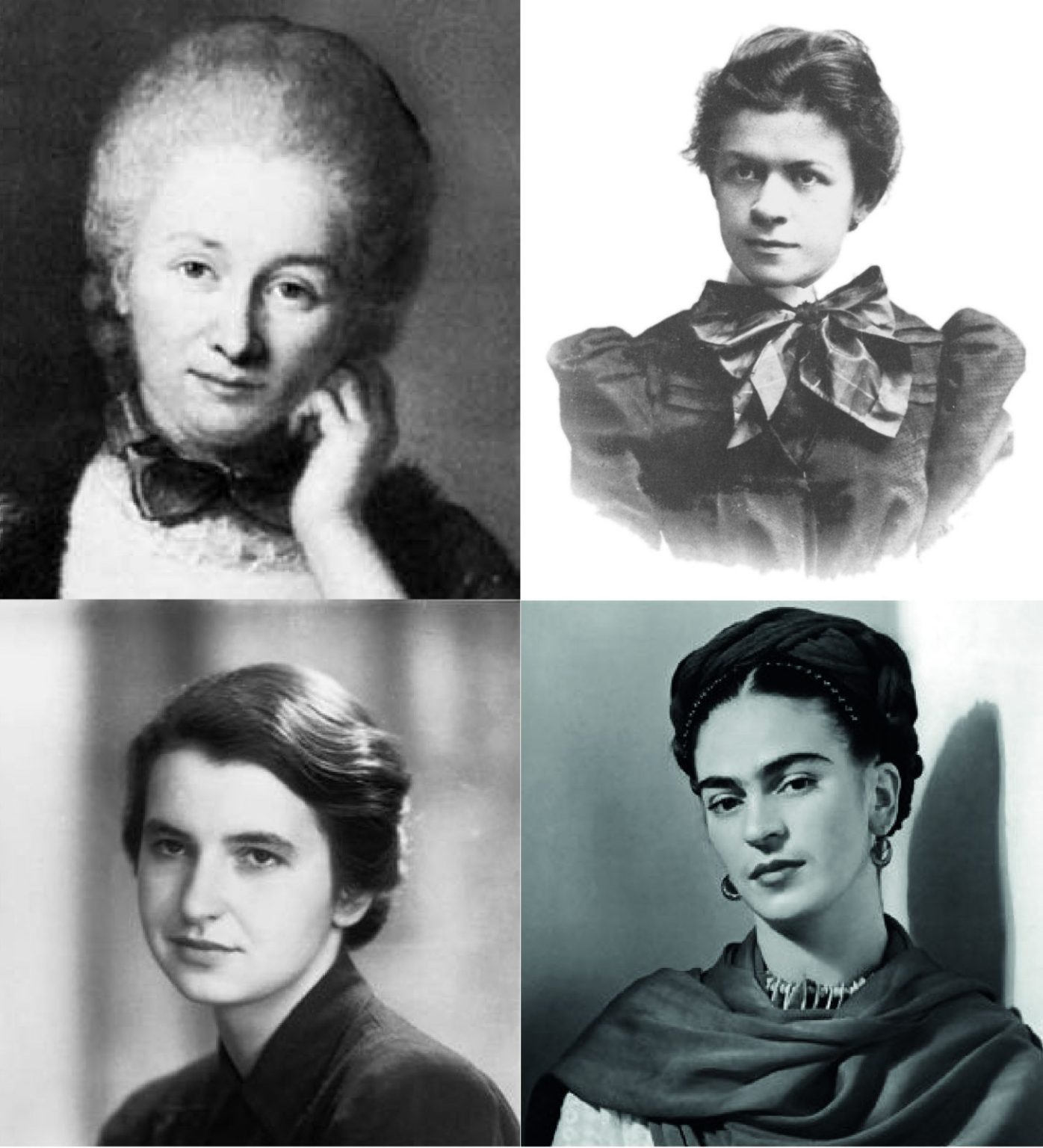
On the occasion of International Women’s Day, Connectors Plus, with a predominantly female team, reaffirms its commitment to defending gender equality and women’s empowerment. We want to support and defend the rights of each and every woman, regardless of her race, ethnicity, orientation, ideals, beliefs, religion, customs, culture… And to highlight the indisputable contribution they make to our society every day. Examples of this “invisible” contribution throughout history are these women who, although in their time they were relegated to the background, their contributions, knowledge, ideas and motivation left important marks in such significant areas as science, art, literature and politics. Frida Khalo, in the shadow of the great Diego Rivera A woman who made history and developed her own style, greatly influenced by her life and Mexican roots. However, her work was always overshadowed by that of her husband, Diego Rivera, the first great admirer of Frida Kahlo. Kahlo’s work did not receive the recognition it deserved until shortly after her death, when she was recognized worldwide at the same level as Rivera. Rosalind Franklin, the great forgotten woman of the discovery of DNA Without their work, the double helix structure of DNA would not have been discovered, and without it, many of the advances in molecular genetics of the 20th century might not have been possible. Franklin studied at Cambridge University and became a researcher at King’s College London, one of the most prestigious colleges of the time. She managed to x-ray the structure of DNA in the famous photograph 51, an image that later allowed Watson and Crick to confirm their double helix theory. However, Franklin never received recognition for her extremely important role. Gabrielle Émilie, the woman who translated Newton At a time when women’s access to education was restricted, one of the great mathematicians of the 18th century, Emilie du Châlet, emerged. In 1737, she published an important piece of research that predicted what we now know as infrared radiation and the nature of light. Her great mind has been compared to that of Horace and made her Newton’s translator, but her 15-year relationship with the scientist relegated her to the background. In debt and without company, she died without obtaining the recognition deserved for her work. Mileva Maric, at the level of Albert Einstein “We have recently completed a very important work that will make my husband world famous” was the phrase that this Serbian mathematician wrote to a friend before Einstein published the articles that made him the most famous scientist of the 20th century. Phrases such as “our research” or “our work” raised questions about the influence that Maric, his first wife, had on Einstein’s work, since their relationship went far beyond the sentimental, as they always worked together and their scientific debates were frequent.

Christmas vocabulary in English
Here are eight typical traditions of English Christmas vocabulary!!! CRACKERS If you go to the UK during Christmas you will see a kind of cardboard rolls wrapped in a beautiful and colorful Christmas paper, and you will ask yourself: What is that? Well, they are crackers!! Fun firecrackers with a surprise and gifts inside, mini Christmas piñatas of the British tradition!! CHRISTMAS DAY On Christmas Day, it is typical for the family to get together to eat roast turkey or chicken with vegetables and potatoes, and after dinner or the next morning, to exchange presents, especially to children! ¡PUDDING! A delicious, spiced fruit pudding, which dates back to the Middle Ages, is often one of the English favourite desserts at Christmas. And if you haven’t tried it, you have to try it at least once in your life! ¡MINCE PIES! Another typical Christmas sweet is mince pies, delicious pastries filled with minced meat, fruit, cinnamon, cloves and nutmeg! ¡PORT Y MULLED WINE! It is a sweet and warm wine that is drunk in bars and homes, often warmed in a pot and served with a ladle! This is for the more traditional ones. BOXING DAY Do you know the history of Boxing Day? Nowadays it is a day of sales, but in the past it was the day off for servants after Christmas and each one was given food and sweets to share with the family in a little box, that’s why it is called Boxing Day! STOCKINGS These are the socks that people put presents in. If in Spain they are shoes, in the UK they are socks! CHRISTMAS CAROLS! They are English Christmas carols, no more, no less. Write it down because knowing this word is definitely a plus!! And now we only have to tell you: ¡¡¡¡¡MERRY CHRISTMAS AND A HAPPY NEW YEAR!!!! Photo by Wesley Tingey on Unsplash

The advantages of studying your Degree or Master’s in the UK
Are you thinking about studying a degree or Master’s degree in the United Kingdom? If you are thinking of studying a degree or master’s degree in the UK, the possibilities and advantages for you are endless. To start with, first and foremost: you will acquire the Anglo-Saxon methodology. This methodology will help you find work, to maximize your capacity for synthesis, practicality, the achievement of specific objectives and skills that are specified at the beginning of each semester, formality, concreteness and critical expression. The idea at English universities is that at the beginning of the semester the objectives are very clear and the materials are always available to you online. This advantage, together with the fact that the number of class hours (lecture hours) are so reduced in the UK, allows you as a student to organize yourself in your own way, study or read the syllabus in advance and prepare your questions to ask in the next class. The idea at English universities is that the lectures are introductions, and that you can prepare your study before the seminars. In other words, it is the student who sets his own pace and not the other way around as in Spain. This makes it easier for you to never get lost, since you always have all the content online and know what happens in the next session, but also, if you do happen, there are always tutors and follow-up available to you as a foreign student to help you with your studies. Another advantage of this process is that you become bilingual, and I speak from personal experience. A bilingual person is someone capable of expressing themselves masterfully and with total skill in two different languages, and that person is you after your linguistic immersion process during your degree or master’s degree. Going to class every day, listening to lectures, reading and writing in another language, solving problems, thinking, working in a team or making friends, makes you acquire a spectacular mastery of the English language without realizing it, through a natural process of linguistic immersion. It is not surprising, therefore, that 86% of students who complete their degrees in the UK find work during that year. Bilingualism and a practical methodology focused on achieving objectives and the workplace make students trained in the UK highly prepared for the job challenges of today’s world. If you are thinking about it, try a stay this year, improve your English, and have fun!
English culture, essential curiosities
English culture: practical advice from Elena Rodríguez. Chapter I. First and foremost: England is not Spain. In English culture it is difficult to get an interview if you have no real chance of being hired. Even so, if you were to apply for a job or a place at university and they told you they loved you with a huge smile on their face and then they didn’t call you or rejected you: don’t worry. Don’t look for three feet on a cat and of course: don’t get discouraged. Try again and keep going like they do: with a huge smile on your face, but keep in mind a couple of things. First of all, you have to go to England with your homework done. Knowing the characteristics of the type of company or university you want to apply to, thinking very carefully about what you have to say: that it is the most wonderful university in the world, that there is no more stimulating job for you, that the food is the most delicious you have ever tasted in your life, etc. It is about pleasing with words. Reality is quite different. You should always smile and speak in a sweet and effusive tone. And note that these tips I give you are not only useful for applying for a job, they are also useful for learning English. Don’t say the phrases in the Spanish way, say them with enthusiasm, like the English, as if they were always dealing with very interesting and wonderful things, even if you are talking about the clouds in the sky. This is very important, believe me! I had to look like a shrimp many times before I understood that people didn’t smile at me because they really liked me, but because they are like that, they are always like that even if they are throwing things at each other, it is a cultural issue like many others that I will reveal to you in the next chapters. Sincerely (you know what I mean): Elena Rodríguez.